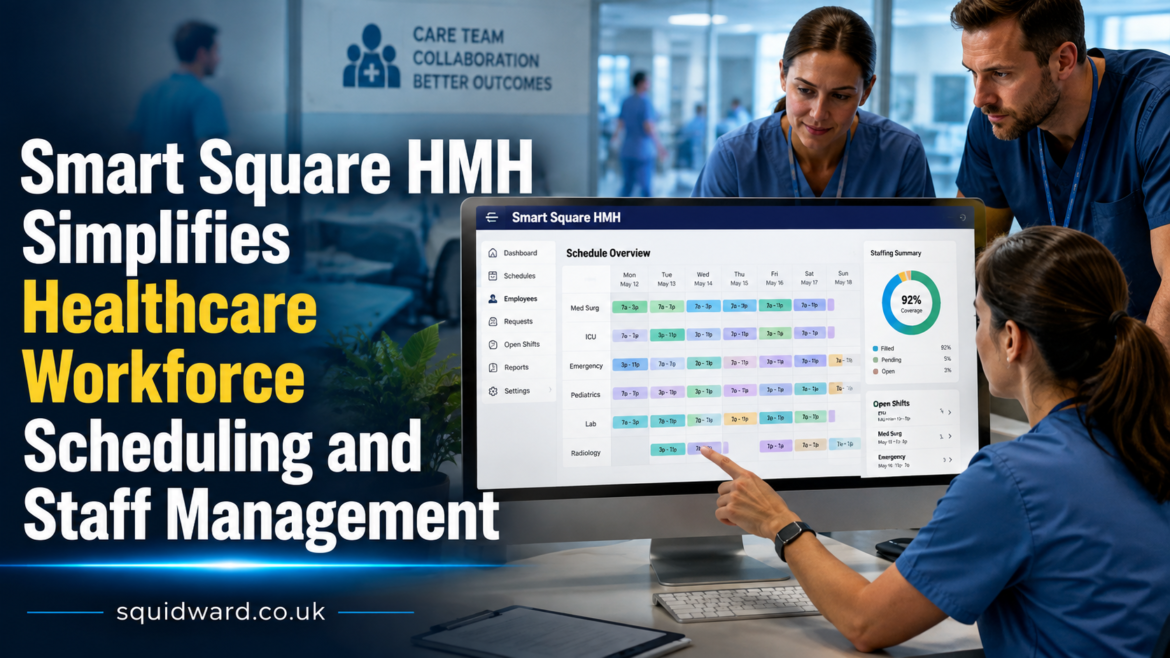
Healthcare organizations have to coordinate employees across departments, locations, shifts, and changing levels of patient demand. Managing that workload through disconnected spreadsheets or older scheduling systems can make it harder for managers to see staffing gaps and for employees to understand their schedules. Smart Square HMH addresses this challenge by giving Hackensack Meridian Health a more centralized approach to healthcare workforce scheduling and staff deployment.
In this context, HMH refers to Hackensack Meridian Health, the New Jersey-based nonprofit health network. Smart Square is a healthcare-focused scheduling platform that combines workforce scheduling with predictive staffing tools and operational data. Hackensack Meridian Health adopted the system as part of a broader effort to improve staffing visibility, scheduling efficiency, and use of its workforce. According to a Smart Square customer case study published by symplr, HMH first implemented the technology at five hospitals before expanding its use during the COVID-19 pandemic.
What Smart Square HMH Is and How It Supports Workforce Management
Smart Square HMH can best be understood as Hackensack Meridian Health’s implementation of the Smart Square workforce scheduling platform. The software was designed specifically around the complicated staffing requirements found in healthcare environments, where a schedule has to account for more than simply placing an employee on a particular shift.
Hospitals frequently need to consider expected patient demand, available employees, workforce commitments, department requirements, open shifts, and last-minute staffing changes. Smart Square brings these factors into a system that gives managers a clearer picture of staffing requirements.
The underlying Smart Square platform uses predictive analytics to help organizations anticipate staffing demand rather than depending entirely on last-minute decisions. Current information from symplr says Smart Square can combine real-time census trends, historical patterns, and staffing standards to produce demand forecasts as far as 120 days ahead. The company states that its forecasting can reach 96 percent accuracy, although actual results will naturally depend on an organization’s data, configuration, and operating environment.
This predictive approach is important because healthcare staffing rarely remains static. Patient volumes change, employees request time off, shifts become vacant, and individual departments may suddenly require additional coverage. A scheduling platform cannot remove those changes, but it can make them easier to identify and manage.
Smart Square HMH Helps Organize Employee Scheduling
One of the central purposes of Smart Square HMH is to make scheduling more organized across a large healthcare network. Hackensack Meridian Health operates hospitals, ambulatory locations, specialty services, and other healthcare operations, which creates a considerable workforce-management challenge.
Before its Smart Square implementation, HMH was dealing with older systems that lacked capabilities such as modern self-scheduling. The organization also experienced technical and integration difficulties that made efficient staffing more difficult. According to the published HMH customer story, these problems contributed to what the organization described as FTE leakage—hours employees were expected to work according to their full-time-equivalent commitments but did not actually work.
Moving scheduling activity into a unified platform can give workforce managers a more consistent way to review schedules instead of relying on separate processes between facilities or departments. Managers can identify staffing requirements, compare scheduled resources with anticipated demand, and respond to gaps earlier.
That does not mean every staffing decision becomes automatic. Healthcare managers still need to apply operational judgment. Smart Square instead provides information and scheduling tools that can support those decisions.
Staff Can Review Shifts and Manage Schedule Changes
Modern scheduling software is also useful when employees have greater visibility into their own work schedules. Smart Square includes features aimed at giving clinicians more control over routine scheduling activities.
The Smart Square Go mobile application, for example, is an extension of the main Smart Square environment. According to its current application information, clinicians with an active Smart Square account can view and pick up available shifts, submit requests for time off, request shift trades, request to work, receive scheduling notifications, and synchronize their work schedule with a personal calendar. It also supports secure authentication technologies including single sign-on and Active Directory.
The exact features available to an HMH employee can depend on how Hackensack Meridian Health has configured its system and the permissions associated with that person’s role. Employees therefore should not assume that every general Smart Square feature is enabled in their HMH account.
For daily workforce management, however, employee access to scheduling information can reduce unnecessary back-and-forth communication. Instead of depending only on phone calls, messages, or manually distributed schedules, staff and managers can work from a more consistent scheduling environment.
Managers Can Use Scheduling Data to Plan Staffing Needs
The more significant value of Smart Square goes beyond displaying a calendar. Predictive staffing and workforce analytics are designed to help managers understand whether scheduled staffing levels match expected requirements.
Smart Square provides dashboards that can give managers a broader view of staffing needs. At Hackensack Meridian Health, these dashboards were part of the organization’s effort to make informed workforce decisions and improve staffing efficiency. HMH implemented the platform in stages, beginning with five hospitals and later expanding it as staffing pressures increased during the pandemic.
Being able to see future demand is especially useful in healthcare because waiting until a shift is about to begin leaves managers with fewer options. Earlier visibility can provide more time to fill open shifts, adjust staffing plans, or evaluate whether scheduled resources match anticipated workload.
Current Smart Square capabilities include predictive analytics, real-time staffing adjustments, open-shift management, and nurse-competency integration. These functions are intended to help healthcare systems develop schedules that better reflect operational demand.
Smart Square HMH Supports Better Workforce Coordination
A large healthcare network does not operate as a single department. Different facilities and clinical units have their own staffing patterns, patient volumes, skill requirements, and operational pressures. One benefit of Smart Square HMH is therefore the ability to approach scheduling on a larger scale while still giving managers useful information at the department level.
HMH’s experience demonstrates why standardization can matter. The organization moved toward a unified and scalable scheduling platform rather than maintaining disconnected approaches across its network. This can improve visibility because managers have a clearer framework for understanding workforce commitments and staffing requirements.
The HMH case study reported measurable results from this approach. By focusing on FTE leakage as an important workforce metric and working with nurse managers to improve scheduling practices, HMH reported a 6.5 percent reduction in FTE leakage compared with the previous year. The case study also reported approximately $616,000 in annual savings associated with optimized staffing.
These figures should be understood as Hackensack Meridian Health’s reported results rather than a guaranteed outcome for every Smart Square customer.
Mobile Access Makes Schedule Management More Convenient
Healthcare employees do not spend their entire working day sitting in front of a desktop computer. Mobile availability can therefore make workforce scheduling considerably more practical.
Smart Square Go provides mobile access to several schedule-management functions for users whose organizations support them. Staff can interact with open shifts, submit certain scheduling requests, see notifications, and keep their work schedule connected with a personal calendar.
Hackensack Meridian Health also operates its broader MyHMH mobile environment for team members. HMH describes MyHMH as a mobile gateway to key areas of its employee intranet, including business tools, MySupport, MyWay-PeopleSoft, PolicyStat, careers resources, and other applications.
It is important not to confuse these services. MyHMH is HMH’s broader employee-access environment, while Smart Square is a workforce scheduling solution. Employees looking for their specific Smart Square access route should follow current instructions supplied by Hackensack Meridian Health rather than relying on unofficial login pages found through search engines.
Smart Square Is Now Part of symplr
The ownership of Smart Square has changed, which is important when reading older information about the platform. AMN Healthcare previously owned the scheduling technology, but symplr announced on July 2, 2025, that it had acquired Smart Square from AMN Healthcare.
As a result, current product information and development of the platform now sit within symplr’s healthcare operations portfolio. The company describes Smart Square as a cloud-based workforce-management solution with AI-driven scheduling, predictive analytics, staffing adjustments, open-shift management, and other healthcare-specific capabilities.
In February 2026, symplr also announced that Smart Square had received the Best in KLAS recognition for Nurse & Staff Scheduling for a second consecutive year. The company highlighted predictive analytics, workforce flexibility, scheduling visibility, and operational impact as key parts of the platform.
Common Smart Square HMH Login and Access Issues
People searching for smart square hmh are often trying to reach a scheduling account rather than researching the software itself. Because employee systems can contain private workforce information, users should be cautious about third-party websites that claim to provide an HMH Smart Square login.
An active organizational Smart Square account is required for Smart Square Go, and the platform supports authentication methods such as SSO and Active Directory. Access permissions may also differ based on the employee’s organization, department, and role.
If an employee cannot sign in, the safest approach is to use the official access method provided internally by Hackensack Meridian Health. Forgotten credentials, expired sessions, account permissions, organizational authentication requirements, or changes to an internal access route can all prevent successful access. HMH’s MySupport resources are also available through the organization’s MyHMH environment for team members.
Users should avoid entering employee credentials into an unofficial page simply because it appears in search results.
Why Accurate Scheduling Matters in Healthcare Operations
Healthcare workforce scheduling has direct operational consequences. Too few available staff can place additional pressure on teams, while unnecessary staffing can increase labor costs. Managers therefore need to balance employee availability with patient demand, department needs, workforce commitments, and appropriate qualifications.
Predictive scheduling provides a way to approach this task earlier. Smart Square’s forecasting tools are intended to show potential staffing requirements before the actual shift arrives, giving managers time to make adjustments instead of constantly reacting to gaps at the last minute.
For employees, schedule transparency can also make work planning easier. Features such as open-shift visibility, scheduling requests, notifications, and calendar synchronization create a clearer connection between employees and the staffing process.
The value of the technology ultimately depends on how effectively an organization configures it, maintains accurate workforce information, and incorporates the system into its management practices.
Smart Square HMH Brings Scheduling Tools Into One System
Smart Square HMH represents Hackensack Meridian Health’s use of a healthcare-specific workforce scheduling platform to improve staffing visibility and coordination across a complex health network. Rather than treating scheduling only as a calendar-building exercise, Smart Square combines schedules with predictive staffing information, workforce analytics, open-shift management, and tools that support employee participation.
Hackensack Meridian Health’s published experience offers a concrete example of the platform in operation. HMH introduced Smart Square in stages, expanded it across the network, focused on reducing FTE leakage, and reported both improved workforce utilization and significant annual savings.
For employees, Smart Square can provide a more convenient way to interact with work schedules, while managers gain information that can support staffing decisions before gaps become urgent. Its role is not to replace human workforce planning but to give healthcare teams better tools for making those decisions consistently and with greater visibility.
Frequently Asked Questions
What is Smart Square HMH?
Smart Square HMH refers to Hackensack Meridian Health’s use of the Smart Square healthcare workforce scheduling platform. It supports scheduling, staffing visibility, workforce planning, and staff deployment across healthcare operations.
What does HMH stand for in Smart Square HMH?
In this context, HMH stands for Hackensack Meridian Health, a nonprofit integrated healthcare network based in New Jersey. Its network includes hospitals, ambulatory locations, specialty services, and other healthcare facilities.
Can employees use Smart Square to manage shifts?
Smart Square includes employee-oriented scheduling capabilities. Its Smart Square Go extension allows eligible users to perform functions such as viewing and picking up available shifts, submitting time-off requests, requesting shift trades, and receiving scheduling notifications. Available features depend on the employer’s setup.
Does Smart Square predict future staffing needs?
Yes. Smart Square uses predictive analytics and workforce information to forecast staffing demand. symplr states that the system can produce forecasts beginning up to 120 days before a shift.
Did Hackensack Meridian Health report results from Smart Square?
Yes. According to symplr’s HMH customer case study, Hackensack Meridian Health reported a 6.5 percent reduction in FTE leakage and approximately $616,000 in annual savings after focusing on workforce utilization and scheduling practices.
Who owns Smart Square now?
Smart Square is currently owned by symplr. The company acquired the scheduling software from AMN Healthcare in July 2025 and incorporated it into its healthcare workforce-management portfolio.
Read More: Squidward